
Loss and Resilience
Finding Strength You Didn’t Know You Had
Big Shoes
This week, we’re thinking about the moments when we discovered our own resilience—when we surprised ourselves by surviving, by handling what we didn’t think we could handle, by being stronger than we knew.
Sometimes strength announces itself dramatically—ripping out IVs, making impossible decisions, doing whatever must be done in a moment of crisis.
But more often, strength is quieter. It’s showing up day after day when you’re exhausted. It’s scrubbing toilets to buy your child shoes. It’s sitting in the dark, forcing yourself to breathe through panic, listening for your father’s voice telling you how to survive. It’s choosing to educate when you could give up. It’s refusing to be another statistic when everything in your situation says you will be.
This week, we’re asking: When did you discover you were stronger than you thought? What did you survive that you didn’t think you could? What capacity did you find in yourself that surprised you?
Sometimes we don’t recognize our own strength until we look back and think, “How did I do that? How did I survive?” Sometimes someone else points it out—”You’re so strong”—and we want to laugh because we don’t feel strong, we just feel like we’re barely holding on.
But that’s what strength actually looks like. Not confidence or certainty. Just showing up. Day after day. Filling shoes that seem too big. Doing what needs doing because there’s no other choice.
When did you discover your own resilience? What surprised you about your own capacity?
Big Shoes
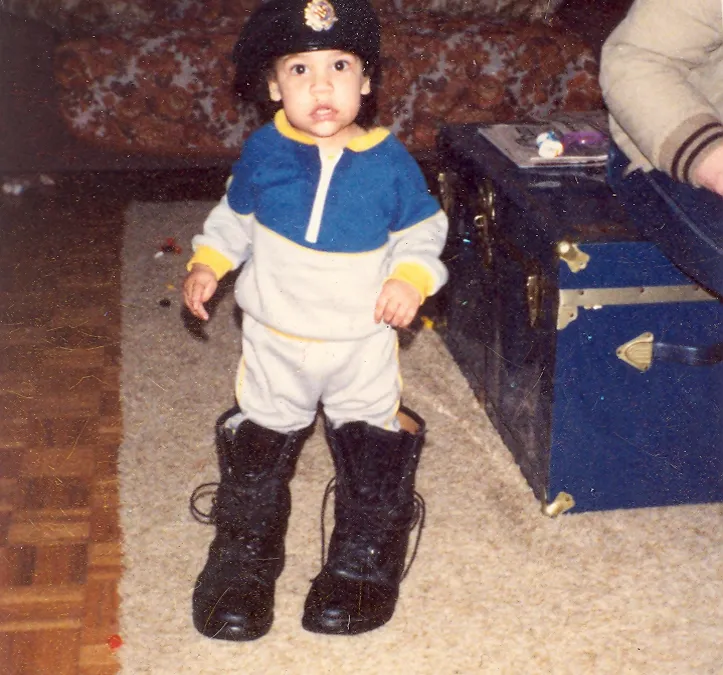
My son Matt was a year old in this picture. He’s standing in my friend Dan’s army boots. This photo was taken several months after I’d left my husband and moved to a new city.
Once the shock of my dissolving marriage subsided, the reality of my situation began to sink in. I was a woman with no money and few marketable skills, and now I had a family to raise.
My mother tells me that her parents supported nine children through the Depression and never went on the dole. I remember her telling me this when I was a child, and when she said it, she sounded so proud.
When I left my husband, I had a two-year-old toddler, an eight-month-old baby, and $14 to my name. So I swallowed my inherited pride and went on the dole.
I received just over $600 a month, and this crappy little place cost $290 a month. Thank goodness the previous tenants left that old lumpy sofa you see in the background, because that gave me something to sleep on.
As I’d tuck my two babies in each night, the weight of the responsibility I had to them was nearly suffocating. I knew their future, whatever chance they had in life, was totally dependent on the decisions I’d make, and I was determined we would not be another statistic.
In those anguished, lonely nights, I’d sit on that sofa in the darkness of that tiny living room and listen. I’d try to still my breathing, my thoughts, and the nauseating panic. I’d force myself to focus on the muffled sounds of distant traffic, the neighbour’s droning television, the raindrops’ patter on the window, until I could hear nothing but my own breathing.
Only then could I hear the whisper of my father’s voice: “Educate to elevate.”
I had met Dan’s wife Marlene in the first weeks in my new city. Although I couldn’t pay her very much, she agreed to babysit my kids whilst I took courses to upgrade so I could get into university. Between classes, I got a job cleaning rich people’s houses for grocery money or a new pair of shoes for Matt. He was growing so quickly and was so hard on his shoes.
He was my little man. The most important man in my life. I named him Matthew because I once read somewhere that “Matthew” meant God’s gift. Matt was a twin. As a consequence of one of my husband’s outbursts, I lost his twin but miraculously, carried Matt to term. That he was even born (and born on Christmas Day no less) was a gift.
I’d gladly scrub toilets to buy him shoes.
The day I took this picture, I remember wondering what kind of man would grow to fill those boots. Would I be able to raise a good, strong, and kind man? Or would I, in my desperation to survive—to keep us fed, clothed, and housed—make some misstep and fail him?
It seemed we both had to fill big shoes.
What I Discovered About Myself
I discovered that I could survive what I thought would destroy me.
I didn’t feel strong. I felt terrified. Every night, tucking my babies into bed, the weight of being solely responsible for their future nearly suffocated me. Every night, sitting on that lumpy sofa in the dark, trying to breathe through panic, trying to hear my father’s voice over the noise of my own fear.
But I showed up anyway. I swallowed my inherited pride and went on the dole. I took courses. I cleaned rich people’s houses. I bought my son shoes. I refused to be another statistic.
That’s what strength actually is, I learned. Not feeling confident or capable. Just doing what needs doing because there’s no other choice.
I discovered that I could fill shoes that seemed too big.
I was a woman with no money and few marketable skills, trying to raise two babies alone in a new city. Everything about my situation said I wouldn’t make it. Statistics said I wouldn’t make it. But I was determined that we would not be another number, another story of a single mother who couldn’t manage, who gave up, who failed her children.
So I didn’t give up. I educated to elevate, like my father taught me. I scraped together money for babysitting and took upgrading courses. I scrubbed toilets for grocery money. I made it work because it had to work.
I discovered that love makes you capable of things you didn’t know you could do.
I named him Matthew—God’s gift. He was a twin. I lost his twin but carried Matt to term. That he was even born was a gift. And I’d do anything for that gift. Scrub any toilet. Swallow any pride. Sit in the dark night after night, forcing myself to breathe through panic, listening for my father’s voice.
I’d gladly scrub toilets to buy him shoes.
That’s what I discovered about myself: that maternal love is fierce enough to make you strong when you don’t feel strong. That you’ll do whatever it takes—whatever humiliating, exhausting, soul-crushing thing needs doing—if it means your children have a chance.
I discovered that resilience isn’t a feeling. It’s a choice you make every day.
Every night I sat on that sofa and listened. To the distant traffic, the neighbour’s television, the rain on the window, my own breathing. Trying to quiet the panic. Trying to hear my father’s voice. Trying to remember that I could do this.
Some nights I believed it. Some nights I didn’t. But every morning I got up anyway. Took care of my babies. Went to class or went to clean houses. Did what needed doing.
That’s resilience. Not confidence. Just showing up. Day after day. Even when you’re terrified. Even when you don’t know if you can do it. Even when everything says you’ll fail.
You just keep going. Because your children need shoes. Because you refuse to be another statistic. Because your father’s voice whispers “Educate to elevate” and you choose to believe him.
Looking Back
Matt is grown now. He filled those boots and then some. He became a good, strong, kind man. The kind of man who sobbed holding his dying dog, who asked if he’d done the right thing, who tenderly cradled that little body and buried him himself.
I didn’t fail him.
And looking back at that young mother sitting on a lumpy sofa in a crappy little flat, $14 to her name, two babies to raise, wondering if she had the strength to fill shoes that seemed too big—I want to tell her:
You’re stronger than you know. You’ll surprise yourself. You’ll survive what you think will destroy you. You’ll scrub toilets and feel glad to do it. You’ll sit in the dark and breathe through panic and hear your father’s voice and get up the next morning and do it all again.
You’ll fill those big shoes. Both of you will.
Not because you’re special. Not because you’re brave. But because you refuse to be another statistic. Because you have two babies who need you. Because love makes you capable of things you didn’t know you could do.
You’ll discover that strength isn’t a feeling. It’s just showing up. Day after day. Doing what needs doing.
And that will be enough.
This Week’s Prompts: Finding Strength You Didn’t Know You Had
When you surprised yourself by surviving. What did you survive that you didn’t think you could? When did you look back and think “How did I do that?” What carried you through?
The moment you realised you were stronger than you thought. Was there a specific moment when you recognised your own resilience? When you understood that you’d been strong all along, even when you didn’t feel strong?
Filling big shoes. When have you faced a responsibility that seemed too big for you? How did you handle it? What did you discover about your own capacity?
What you did for love. What have you done—humbling, exhausting, difficult things—because you loved someone and they needed you? How did love make you capable of more than you knew?
The voice that guided you. Whose voice did you hear in the dark moments? Whose wisdom or example helped you keep going? What did they teach you about surviving?
Quiet resilience. Not the dramatic moments, but the day-after-day showing up. When have you been quietly resilient—just getting up every morning and doing what needed doing, even when you were terrified?
Looking back at your younger self. If you could talk to yourself during your hardest time, what would you say? What do you know now about your own strength that you couldn’t see then?
Invitation to Engage
Over the past two weeks, we’ve shared stories about loss and crisis—PK and the impossible decision, ripping out IVs to get to our children, the things that broke and the things that held.
This week, we’re thinking about discovering our own resilience. Not the dramatic moments (though those count too), but the quiet, day-after-day strength of just showing up. Of scrubbing toilets for shoes. Of sitting in the dark and listening for wisdom. Of refusing to be another statistic.
When I left my husband, I had two babies and $14. I sat on a lumpy sofa in a crappy little flat every night, trying to breathe through panic, listening for my father’s voice: “Educate to elevate.” I cleaned rich people’s houses for grocery money. I gladly scrubbed toilets to buy my son shoes.
I didn’t feel strong. I felt terrified. But I showed up anyway. Day after day. Because I refused to be another statistic. Because my children needed me. Because love makes you capable of things you didn’t know you could do.
When did you discover you were stronger than you thought? What did you survive that surprised you? What big shoes did you fill?
Share your story in the comments. I’d love to hear about the quiet resilience, the day-after-day showing up, the moment you realised you’d been strong all along even when you didn’t feel it.
Strength isn’t confidence. It’s just showing up. Day after day. Doing what needs doing.
And that’s enough.
First published in The Story Harvesters newsletter on Substack, June 15, 2026.
Comments were part of the original newsletter and aren’t included in this archive.