What I Inherited
What I Inherited
Family Heirlooms
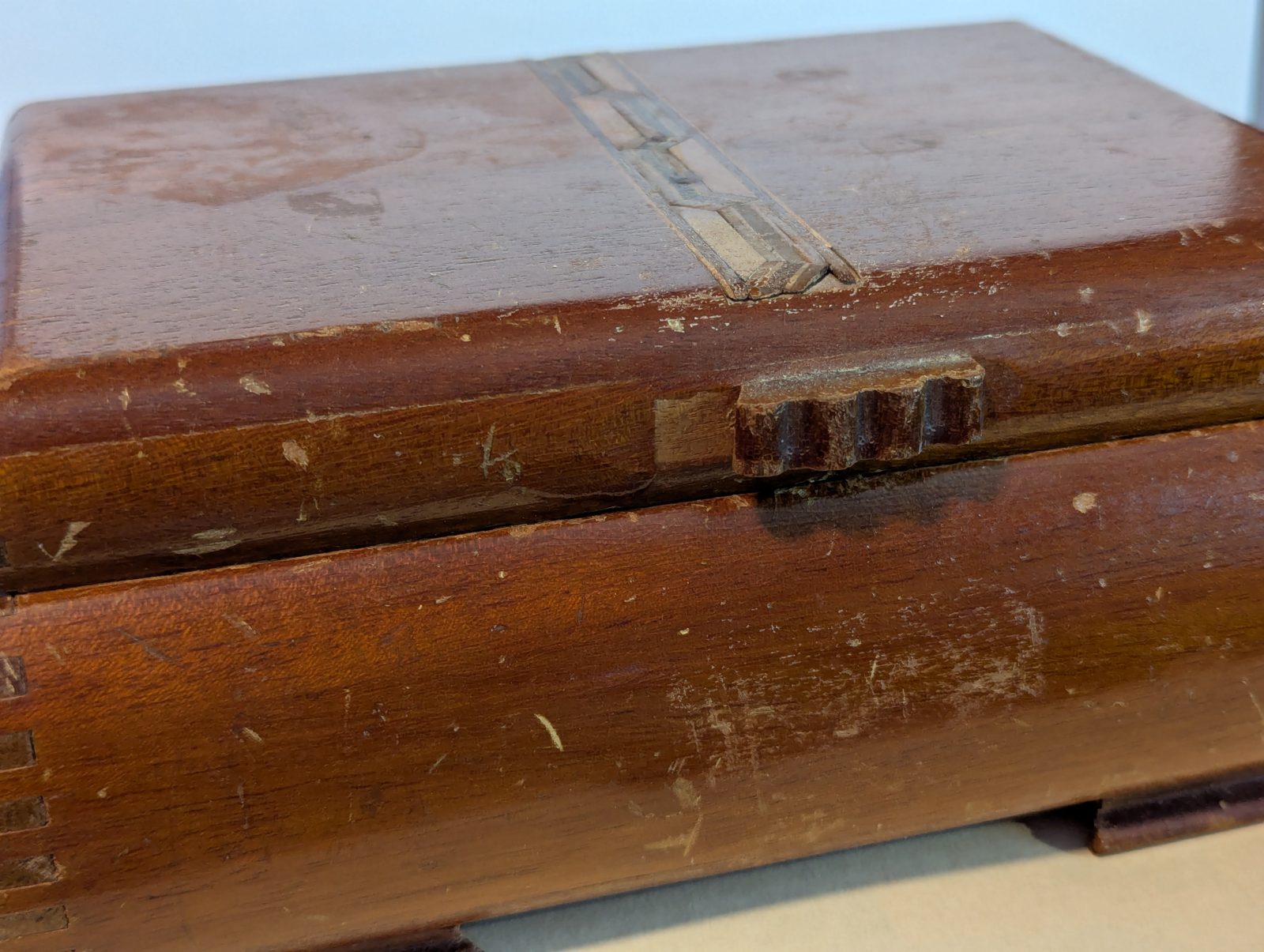
The jewellery box sits on my dresser now, just as it sat on my mother’s dresser for all the years I was growing up.
It’s nothing fancy—6x9 inches, four inches tall, with a strip of wood marquetry inlaid across the top. A mirror inside the lid. No compartments, no velvet lining. Just a simple wooden box.
When it was my mother’s, it held costume jewellery—a pair of pearl clip-on earrings, a modest string of fake pearls. Not valuables. Not heirlooms passed down through generations. Just the pretty things she wore to church on Sundays, the small tokens of adornment she allowed herself.
I must have been around twelve when she gave it to me. I don’t remember if I asked for it or if she simply offered it, seeing how I’d admired it. But it became mine, and it has travelled with me to every place I’ve lived since I left home.
What I keep in it has changed over the years, but the impulse is the same as my mother’s: to hold onto beauty, to preserve small moments, to keep safe the things that mark who we’ve been.
My First Communion charm bracelet, gold and delicate. The fragile silver chain I wore as a flower girl when I was four—it’s in an envelope now, my mother’s handwriting on the outside. My first watch, received when I was six. A rhinestone brooch. Silver religious medals. A brass incense pot from my teenage years, when I burned jasmine-scented cones in my room. Pretty rocks I’ve picked up from places I’ve travelled—I can’t help myself, I find myself reaching down for them, drawn to their colours and smoothness. Name tags from my years as a tour manager, a job I didn’t start until I was fifty-two, but that changed how I saw the world. A letter from my mother’s friend, with snapshots of her family tucked inside. A Toastmasters ribbon from a Table Topics contest I won. A small copper letter opener with a totem pole handle topped with a Canadian maple leaf.
None of it is valuable. None of it would mean anything to anyone else.
But when I open that box and look through these things, I’m looking at my life in fragments. The child at her First Communion. The teenager burning incense. The young mother. The traveller picking up rocks. The woman who reinvented herself at fifty-two. Each object marks a moment, a phase, a version of myself.
And when I see my mother’s handwriting on the backs of photos, on that envelope holding the silver chain, I feel connected to her in a way that transcends death, transcends time, transcends even the fading of memory.
My mother died in 2010. By then, Alzheimer’s had already taken most of her memories. She didn’t remember giving me this box. She didn’t remember the pearl earrings she’d kept in it, or the Sunday mornings she wore them to church.
But I have the box. And in having it, I have something she gave me beyond the physical object itself.
Why This Theme Matters
We inherit so much more than objects. We inherit ways of being in the world. Beliefs about what matters and what doesn’t. Fears and strengths. Patterns of relating, ways of loving, strategies for surviving. Stories about who we are and where we come from. Wounds and wisdom, often tangled together.
Some inheritances we’re grateful for. Others we wish we could return. Most are complicated—gifts wrapped in struggle, strengths forged from difficulty, love expressed in ways that both helped and harmed.
This month, we’re exploring what we inherited—the heirlooms we can hold in our hands and the ones we carry inside us. We’re asking: What did we receive from those who came before? What are we keeping? What are we releasing? What are we choosing to pass forward, and what patterns are we determined to break?
What We’ll Explore This Month
Over the next four weeks, we’ll explore inheritance from different angles.
This week (Week 1), we’ll focus on heirlooms—both physical and otherwise. The objects that carry family history, but also the intangible heirlooms: the recipes, the rituals, the ways of doing things that got handed down along with the furniture.
Next week (Week 2), we’ll examine beliefs and values—what our families taught us about money, work, love, success, our bodies, our worth. The messages we absorbed about how to be in the world.
In Week 3, we’ll celebrate gifts and strengths—the positive inheritances. The resilience, humour, creativity, determination we received. The best of what was given to us.
And in our final week (Week 4), we’ll explore breaking patterns—the inherited cycles we recognized and chose to change. The courage it took to do things differently. What we’re choosing to pass forward instead.
Each week, I’ll share prompts to help you harvest your memories, and I hope you’ll share your stories in the comments. Last month, we explored turning points together. This month, we’re exploring what we inherited—and what we’re choosing to do with it.
This Week’s Prompts: Family Heirlooms (Physical and Otherwise)
An object that carries family history. What physical thing did you inherit that means more than its material value? What’s the story of this object? What does it connect you to?
What the object represents. My mother’s jewellery box taught me that beauty doesn’t have to be expensive to matter. What does your inherited object represent? What did it teach you about the person who gave it to you?
Something you wanted but didn’t inherit. Was there an object or story you wish had been passed down but wasn’t? What do you wish you had received?
An intangible heirloom. A recipe you still make exactly as your mother did. A phrase someone always said. A ritual, a tradition. What intangible inheritance do you carry?
An heirloom you don’t know what to do with. Something you inherited that you don’t want or use but feel guilty about letting go. What is it? Why do you still have it?
Invitation to Engage
Last month, we explored turning points—the decisions that changed everything, the moments when life pivoted, the roads we almost took. You shared stories about choices made and not made, about what-ifs that linger, about paths that redirected your lives.
This month, we’re turning our attention to inheritance—what we received from those who came before us, what we’re keeping, what we’re releasing, what we’re passing forward.
This week, we’re thinking about heirlooms—the physical objects that carry stories and the intangible inheritances we didn’t even realize we’d received.
What object connects you to someone you’ve lost? What intangible inheritance do you carry? What are you keeping, and what are you ready to let go?
Share your story in the comments if you’d like. I’ll be here, reading and responding. And if inheritance is complicated for you—if what you received came wrapped in pain as well as love—that’s okay too. Those stories matter just as much. Maybe more.
First published in The Story Harvesters newsletter on Substack, March 2, 2026.
Comments were part of the original newsletter and aren’t included in this archive.